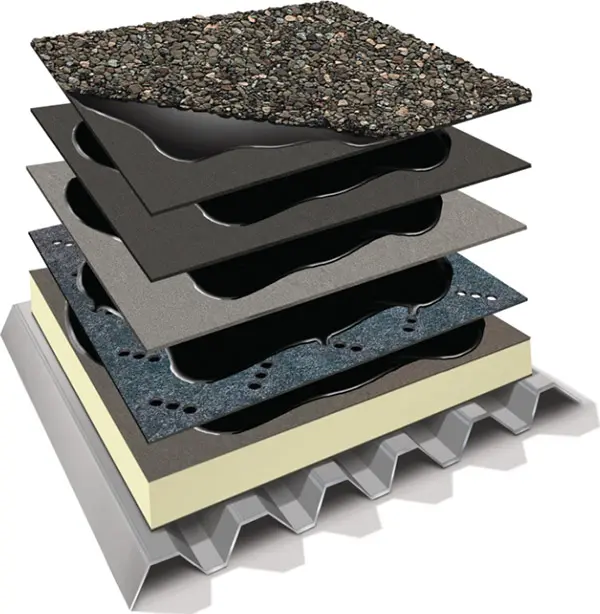
Built-up roofing (BUR) is a continuous, semi-flexible roof membrane consisting of multiple plies of saturated felts, coated felts, fabrics, or mats assembled in place with alternate layers of bitumen. BUR can be surfaced with mineral aggregate, bituminous materials, a liquid-applied coating or a granule-surfaced cap sheet. BUR helps to reduce installation costs while tackling the most demanding roof applications.
Modified Bitumen (Mod-Bit) is made from asphalt that has been modified with one or more polymers or solvents to provide flexibility, impact resistance, and strength. APP Mod-Bit membranes can be torch applied.
EPDM roof systems offer long-lasting durability and versatility, paired with a simple installation and ease of maintenance/repair. When compared to most other commercial roof types, EPDM boasts a strong resistance to ultraviolet light and ozone, and is constructed from a single-ply rubber material.
PVC (polyvinyl chloride) is a reliable and versatile membrane with excellent flexibility, as well as increased resistance to UV, ozone, chemicals, tears, and punctures. PVC membranes feature heat-welded seams, a white reflective color, and ease of repair.
Slate roofs are as old as Colonial America. Because of this, slate is commonly found in historical restorations. Slate is durable, fireproof, and can be very beautiful in its multitude of colors. For that reason, it was commonly found on 19th century roofs, and into the 20th century through the Tudor Revival. On top of being all-natural, slate is long lasting, possibly one of the longest-term investments you can make for your building envelope.
Shingles are most commonly associated with roofs. Asphalt shingles are a popular steep slope roof system and come in several forms and colors. Standard 3-Tab shingles last up to 20 years on a roof, while architectural shingles are thicker, longer lasting and have more options for texture and shape. This allows for a more aesthetically pleasing look than other commercial roofs and more “curb appeal.”